Influencer marketing still often starts from the wrong layer.
Follower counts, average views, niche labels, and a few sample posts. Useful, but thin. Two creators can look identical on a spreadsheet and feel completely different on camera. One always has nails done. One keeps dyeing their hair. One has a cat that never gets a dedicated video, but keeps walking through the background. Those details are soft, repetitive, and easy to miss if you only skim captions.
InfluConnect started from that gap: build creator profiles from what actually appears across their content, then use those profiles to find better brand matches.
The Product Idea
InfluConnect is an AI-assisted influencer marketing platform. Brands describe what they sell and who they want to reach. The platform builds structured profiles of TikTok creators by analyzing their videos, tracking how those profiles change over time, and ranking creators by lifestyle fit, not only by reach.
The useful question is not only "is this person big enough?" It is closer to:
- does their visual world already look like this brand?
- do they repeatedly show habits that match the product?
- is the match obvious in the feed, or only in the bio?
That is where passive signals matter. A nail brand does not only need someone who once posted a manicure. It needs creators whose nails are consistently part of the frame. A pet brand does not only need animal accounts. It needs people whose pet already lives inside their content without being the whole pitch.
Video Analysis as the Engine
The hard part of InfluConnect is not the dashboard. It is turning messy short-form video into structured evidence.
The platform itself lives in InfluConnect: client and talent dashboards, discovery, castings, bookings, messaging, and creator profiles. Inside that product, TikTok analysis is powered by a forked video-analyzer pipeline — LLMs, computer vision, and automatic speech recognition. Each TikTok becomes an analysis object. Across many TikToks, those objects become a person.
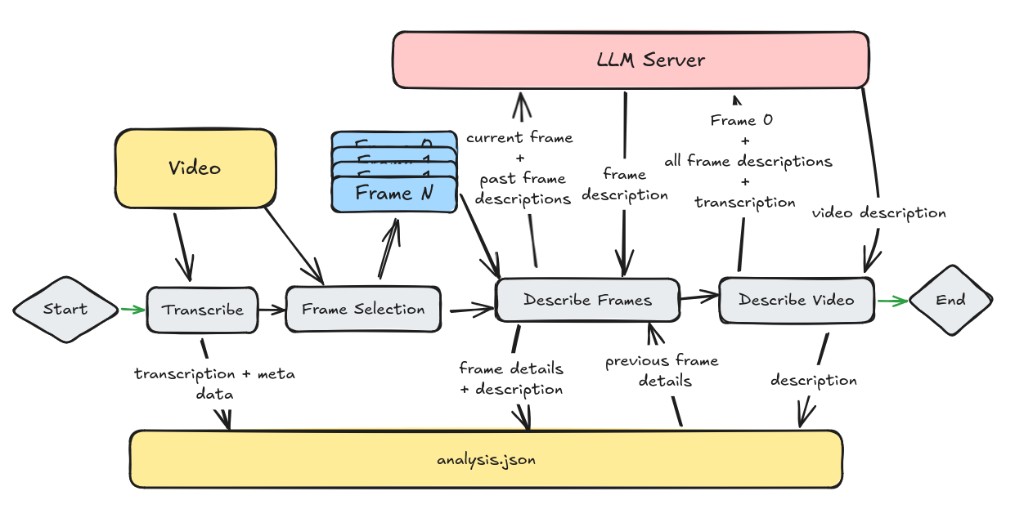
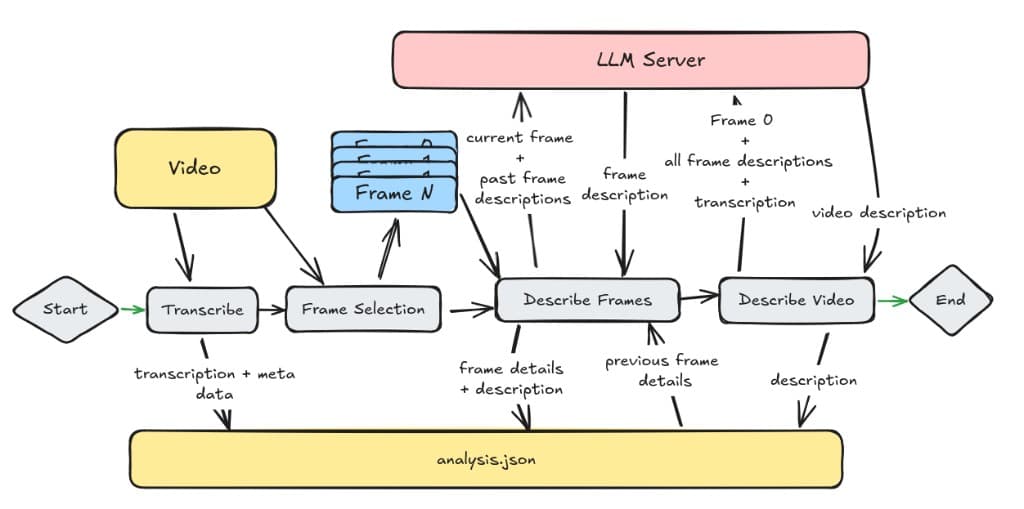
The flow is deliberately layered:
- Transcribe the video and store transcription plus metadata in
analysis.json. - Select frames so the system has a visual sample instead of one random thumbnail.
- Describe frames with an LLM, using the current frame plus previous frame descriptions so the model keeps temporal context.
- Describe the video by sending Frame 0, all frame descriptions, and the full transcription back to the LLM.
- Persist the final description into
analysis.json.
The important design choice is context. Frames are not described in isolation. Each new description can remember what already happened. That makes recurring objects, habits, and styling choices easier to notice than a one-shot caption summary ever would.
From One Video to a Living Profile
A single analysis is still only a clip. InfluConnect becomes useful when those clips accumulate into a creator profile.
Over time, the system starts holding more durable traits:
- pets that appear often but are rarely the topic
- nail care, hair color changes, makeup density, fashion patterns
- home setup, travel rhythm, workout habits, food environments
- tone of speech, pacing, product mention style, and what they never say out loud
Those are the "passive" signals. They are not always claimed in a caption. They leak through the frame. Because the analyzer keeps frame memory inside a video and profile memory across videos, InfluConnect can treat those leaks as evidence instead of anecdote.
That also means profiles can drift. If someone suddenly starts showing gym content every week, or stops showing a pet that used to appear constantly, the profile should update. Discovery based on a frozen bio is already outdated by the next posting streak.
Matching Brands to Worlds, Not Just Niches
Once the profile exists, brand matching becomes a comparison of worlds.
A skincare brand can look for creators whose faces, routines, lighting, and bathroom shelves already feel adjacent to the product. A fashion label can look for silhouette, color discipline, and styling repetition. A lifestyle brand can look for the soft context around the person: apartment, pet, weekends, friends, the small props that keep returning.
The platform can still use conventional marketing metrics. Reach still matters. Engagement still matters. Campaign history still matters. But the ranking layer gets a sharper prior: start from creators whose content already contains the brand's natural habitat.
That changes the discovery loop. Instead of scanning hundreds of profiles and hoping taste is consistent, a brand can ask for creators who repeatedly show a trait, then inspect the evidence trail behind the recommendation.
Why This Matters
Most influencer tools summarize what creators say about themselves. InfluConnect is interested in what the camera keeps proving.
That difference is the whole product bet. Short-form video is dense with unintentional information. Transcription alone misses it. Thumbnails alone miss it. Niche tags miss it. Frame-aware analysis, stored across a creator's TikTok history, is what turns that density into something a brand can actually use.
InfluConnect is the product layer. The forked video-analyzer is the analysis engine underneath it. Together they do one simple job: watch enough of a creator's world, remember the recurring details, and help brands find people who already look like the story they want to sell.
A live build of the platform sits at influ-connect.vercel.app. The source for the product is in the InfluConnect repository.
This project is part of the UNMARKOBLE creative technology portfolio by Marko Andrić, alongside EUROSTAT and the Crowd Flow Control Tower.