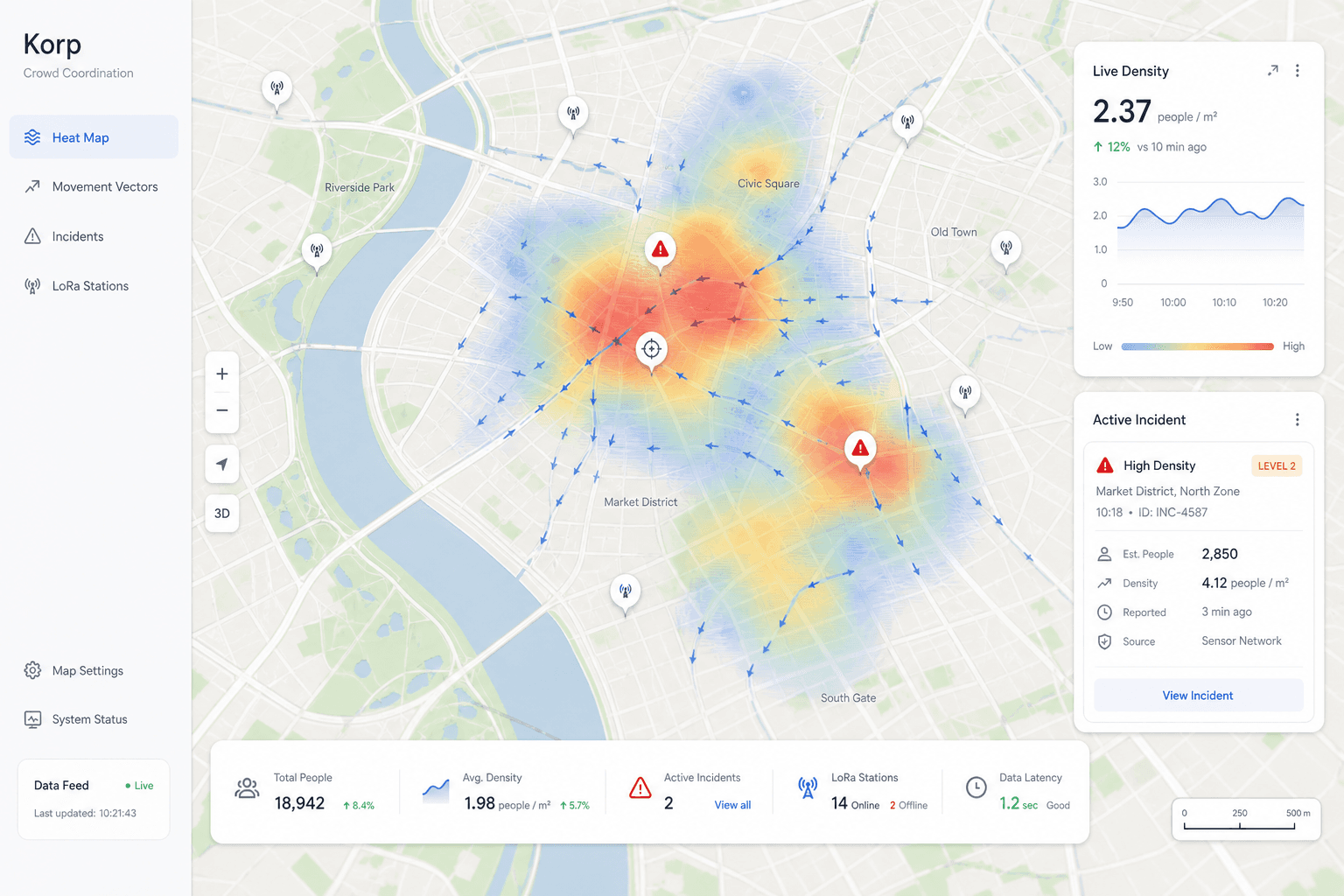
The idea started as a map coordination interface: a place where layers, incidents, personnel, LoRa stations, and live operational status could sit around one shared map. The missing piece was the map becoming intelligent.
That is where the Crowd Flow Control Tower idea fits. Not a camera wall. Not a surveillance product. A control tower for movement: density, pressure points, entrances, exits, bottlenecks, and flow. The kind of system that lets an operations team see a crowd forming before it becomes a problem.
The Concept
The idea was built around small ESP-based sensor modules connected to LoRaWAN devices. These nodes would sit around a venue and listen for short wireless probe signals in the environment. Each observation is weak by itself, but across multiple nodes the space starts to become readable.
The sensors would not need heavy infrastructure. They could aggregate locally, send small payloads through LoRaWAN, and use the Helium network to reach the server. That is what made the idea feel scalable: low-power hardware, long-range transmission, and a backend that turns noisy signals into an operational view.
The product layer would be a live operations map: density estimates, movement vectors, alerts, node health, and playback for understanding how the crowd changed over time.
The Architecture
The cleanest way to understand the system is as a chain: field nodes collect weak signals, the network moves them, the server turns them into temporary clusters, and the dashboard makes the movement readable.
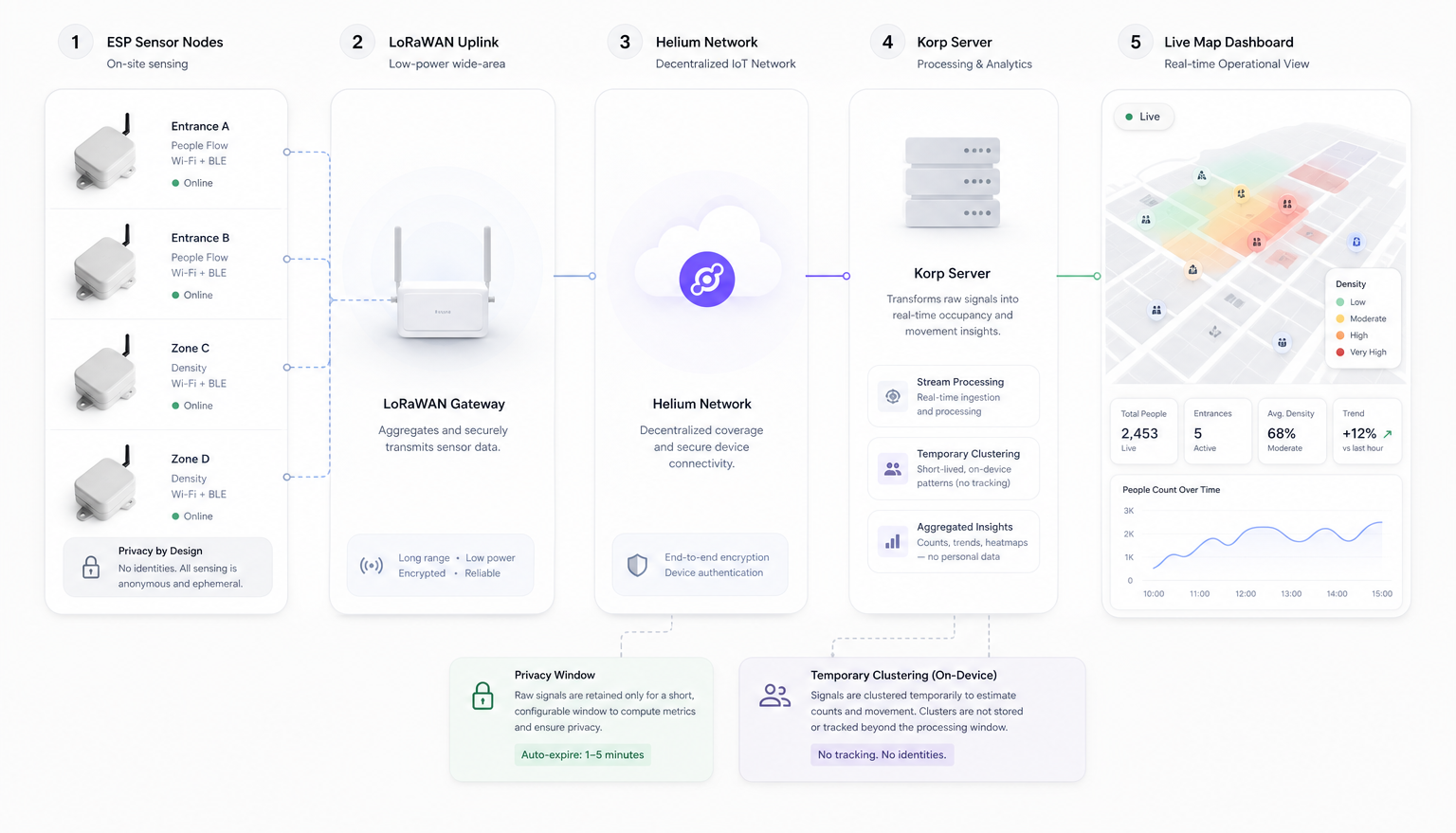
The important part is that the raw signal never needs to become a permanent identity. It becomes a short-lived operational pattern: enough to estimate density, flow, and pressure without turning the system into a person-tracking product.
The Research Problem
The hard part is MAC address randomization.
Modern devices rotate identifiers to prevent simple physical tracking. That protection matters. A serious version of this product cannot treat privacy as a footnote. The useful goal is not "who is this person?" The useful goal is "how is the crowd moving?"
The research I found around this problem shows why the idea is technically possible and why it needs guardrails. In Why MAC Address Randomization is not Enough, Vanhoef, Matte, Cunche, Cardoso, and Piessens show that probe request fingerprints, sequence numbers, and other Wi-Fi discovery behavior can still make randomized devices linkable. Defeating MAC Address Randomization Through Timing Attacks looks at timing signatures in probe requests. A newer paper, De-Randomization of MAC Addresses Using Fingerprints and RSSI With ML for Wi-Fi Analytics, explores fingerprints and RSSI clustering for Wi-Fi analytics.
That research shaped the product direction. The system should use temporary, local, aggregated clusters. It should avoid permanent identity. It should keep raw observations close to the edge when possible, limit retention windows, and expose privacy settings as part of the product, not as legal text hidden below it.
The Interface
The UI direction comes from the existing map coordination dashboard: clean sidebar, map layers, personnel controls, incident cards, floating action buttons, and a bottom status panel. The important upgrade is replacing the empty map surface with a real Apple Maps-like operational layer.
For implementation references, the map layer could be built with something like vis.gl/react-google-maps, while floating operational panels could take cues from Chakra UI Floating Panel, react-driftkit, or a dockable system like dockmanager. The point is not to copy any one interface. The point is the interaction model: a map that stays alive while panels move around it.
The dashboard should answer fast:
- where is the crowd dense right now?
- where is it moving?
- which sensor nodes are healthy?
- where is signal coverage weak?
- what changed in the last five minutes?
- what will become a bottleneck if nothing changes?
Why It Matters
The interesting part of this project is that every layer has a constraint.
The ESP nodes define what can be captured. LoRaWAN defines what can be transmitted. Helium defines how flexible deployment can be. The research defines what can be inferred. The dashboard defines whether the insight is usable. Privacy defines whether the system deserves to exist.
That is why I liked the control tower metaphor. A control tower does not own the sky. It reads signals, understands risk, and helps people coordinate movement in real time.
Crowd Flow Control Tower was a way to think about physical spaces as live systems: noisy, distributed, imperfect, and full of signals that only become meaningful when the architecture is disciplined enough to turn them into a clear operational view.
This concept is part of the UNMARKOBLE creative technology portfolio by Marko Andrić, alongside the UNMARKOBLE brand blueprint.